李健梅微纳和量子光学实验室

Trace Light, Explore Truth

A physics research group exploring nano photonics, quantum optics, nonlinear light-matter interaction, and structured photonic systems.

Overview

Research at the intersection of nanophotonics and quantum optics

Affiliated to the School of Science, Yanshan University, our group devotes itself to frontier researches on micro-nano optics and photonics, adhering to the motto "Trace Light for Principles, Explore Nano to Perfection". We mainly focus on topological photonics, optical field manipulation, artificial micro-nano structure design and optical functional devices. Equipped with complete experimental facilities and professional simulation platforms, we combine theoretical analysis with experimental verification. The group undertakes various scientific research projects and has published many papers in high-level journals. We aim at academic innovation and practical application, and commit ourselves to cultivating high-quality professional talents in optical research.

Focus on micro/nano photonics and quantum optics.
Combine theory, simulation, and optical experiments.
Welcome students interested in nanophotonics and quantum light.

Research

Research Directions

View all
Chiral Photonics and Structured Light Manipulation representative placeholder

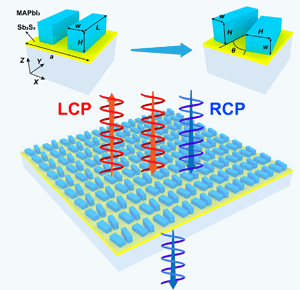
Research on chiral optics and structured light manipulation mainly focuses on the precise control of the polarization, phase, orbital angular momentum and chiral degrees of freedom of light. By utilizing micro-nano structures such as photonic crystals and metasurfaces, this research field realizes circular polarization selection, enhanced chiral response, vortex beam generation, vector optical field regulation and multi-degree-of-freedom beam shaping, which provides novel manipulation methods for chiral sensing, optical communication, quantum optics and integrated photonic devices.
Chiral Photonics and Structured Light Manipulation

Research on chiral optics and structured light manipulation mainly focuses on the precise control of the polarization, phase, orbital angular momentum and chiral degrees of freedom of light. By utilizing micro-nano structures such as photonic crystals and metasurfaces, this research field realizes circular polarization selection, enhanced chiral response, vortex beam generation, vector optical field regulation and multi-degree-of-freedom beam shaping, which provides novel manipulation methods for chiral sensing, optical communication, quantum optics and integrated photonic devices.

Fundamental Design and Physical Mechanisms of Photonic Crystals and Metasurfaces representative placeholder

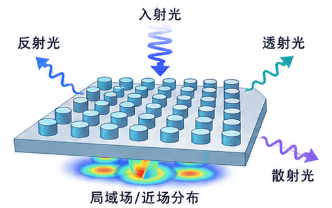
This research direction mainly focuses on the regulation laws of optical fields in micro-nano optical structures. By designing the geometric structures, periodic arrangements and symmetries of photonic crystals and metasurfaces, it realizes the manipulation of light in terms of phase, polarization, propagation direction, localized modes and band structure characteristics. The research contents cover fundamental physical mechanisms including photonic band gaps, high-Q resonances, slow-light effects, flat bands, bound states in the continuum (BIC) modes, mode coupling and far-field radiation. It provides structural design foundations and theoretical support for application fields such as nonlinear optics, quantum light sources, chiral regulation, vortex beam generation and terahertz manipulation.

Fundamental Design and Physical Mechanisms of Photonic Crystals and Metasurfaces

This research direction mainly focuses on the regulation laws of optical fields in micro-nano optical structures. By designing the geometric structures, periodic arrangements and symmetries of photonic crystals and metasurfaces, it realizes the manipulation of light in terms of phase, polarization, propagation direction, localized modes and band structure characteristics. The research contents cover fundamental physical mechanisms including photonic band gaps, high-Q resonances, slow-light effects, flat bands, bound states in the continuum (BIC) modes, mode coupling and far-field radiation. It provides structural design foundations and theoretical support for application fields such as nonlinear optics, quantum light sources, chiral regulation, vortex beam generation and terahertz manipulation.

Machine-Learning-Assisted Design of Photonic Crystals and Metasurfaces representative placeholder

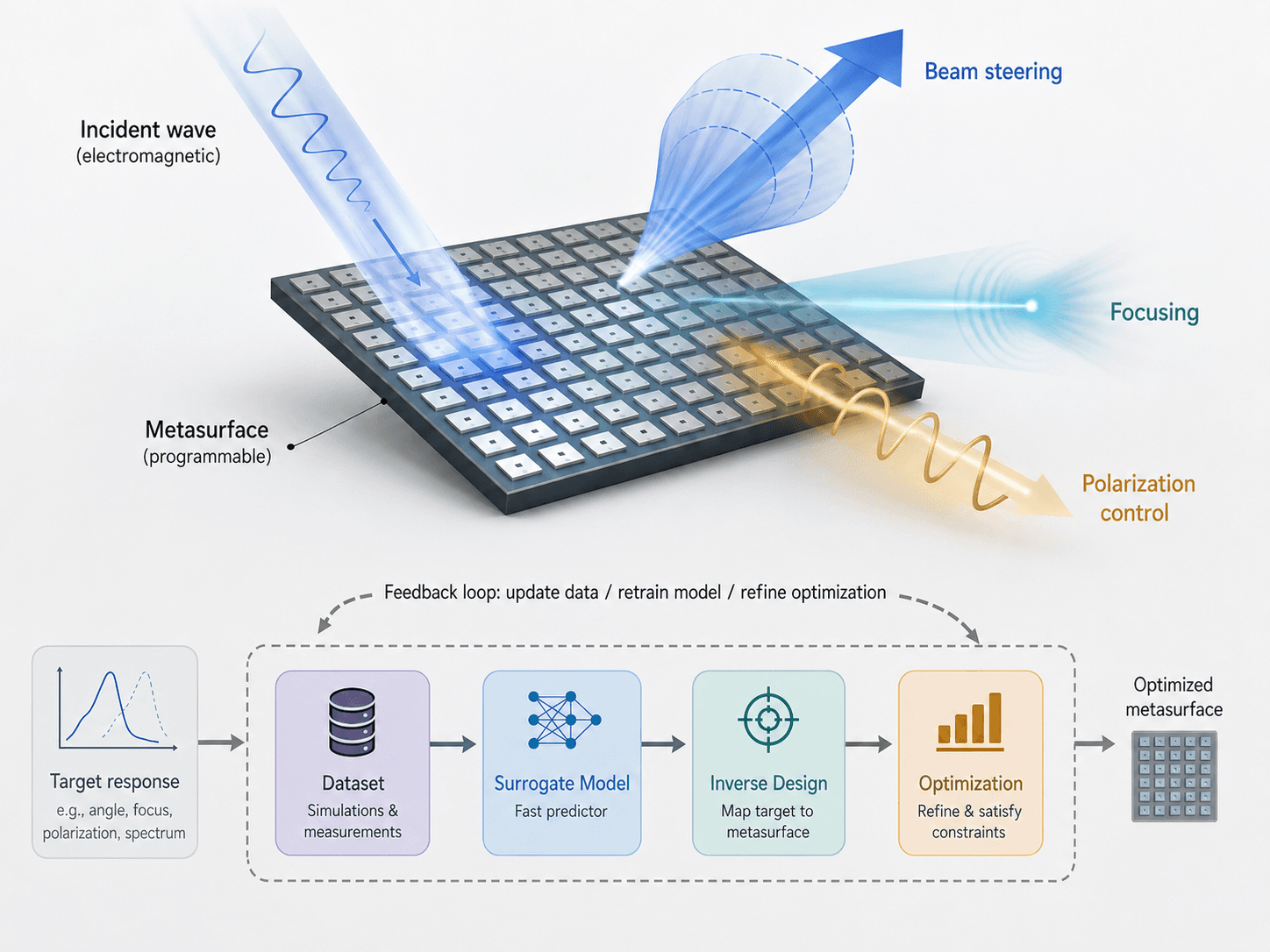
This research direction mainly introduces machine learning methods into the structural design of photonic crystals and metasurfaces. By establishing the mapping relationship between structural parameters and optical responses, it realizes rapid prediction, inverse design and performance optimization of micro-nano optical structures. The research contents include spectral response prediction, mode feature recognition, structural parameter optimization, construction of metasurface unit libraries, and intelligent search for high-performance devices. This direction can break through the limitations of traditional methods such as low efficiency of parameter scanning, complex design space and long optimization cycles, and provide efficient intelligent design methods for high-Q resonance, bound states in the continuum (BIC), nonlinear enhancement, polarization regulation, vortex beam generation and terahertz device design.

Machine-Learning-Assisted Design of Photonic Crystals and Metasurfaces

This research direction mainly introduces machine learning methods into the structural design of photonic crystals and metasurfaces. By establishing the mapping relationship between structural parameters and optical responses, it realizes rapid prediction, inverse design and performance optimization of micro-nano optical structures. The research contents include spectral response prediction, mode feature recognition, structural parameter optimization, construction of metasurface unit libraries, and intelligent search for high-performance devices. This direction can break through the limitations of traditional methods such as low efficiency of parameter scanning, complex design space and long optimization cycles, and provide efficient intelligent design methods for high-Q resonance, bound states in the continuum (BIC), nonlinear enhancement, polarization regulation, vortex beam generation and terahertz device design.

Publications

Selected Publications

Selected papers are controlled by the selected field in Sanity.

Publication list

Placeholder study on high-Q bound states in photonic crystal slabs

2026Selected

Author A, Author B, Principal Investigator Placeholder

Journal Placeholder, TBD, TBD

Bound States in the ContinuumPhotonic Crystals and Metasurfaces

Placeholder integrated SPDC source for entangled photon-pair generation

2026Selected

Graduate Student Placeholder, Collaborator Placeholder, Principal Investigator Placeholder

Quantum Optics Journal Placeholder, TBD, TBD

SPDC Entangled Photon Sources

Placeholder nonlinear nanophotonic resonance engineering in metasurfaces

2025Selected

Author C, Author D, Principal Investigator Placeholder

Nanophotonics Journal Placeholder, TBD, TBD

Nonlinear NanophotonicsPhotonic Crystals and Metasurfaces

Album

Lab and Team Snapshots

Upload group photos, conference photos, experiments, and daily life images in Sanity.

Open album
Group photo placeholder

Group Photos

Group photo placeholder

Conference placeholder

Conferences

Conference placeholder

Experiment placeholder

Experiments

Experiment placeholder

Contact

Interested in our research?

Use the contact page and recruitment page to publish verified addresses, openings, and application instructions.

Contact us